AVP Research Foundation | Clinical Care, Research & Ayurvedic Education

RUDRA
(Random Uninterrupted Documentation for Retrospective Analysis)
Comprehensive Records for Better Care
RUDRA (Random Uninterrupted Documentation for Retrospective Analysis) is a systematic attempt to generate an evidence based approach from the ongoing Ayurvedic clinical practice. It highlights the strengths and limitations of Ayurveda as a preventive and curative modality of healing. RUDRA will lay the foundation to promote Ayurveda as a practice based evidence medicine. The program is designed to facilitate the complete cycle of a clinical encounter customized for Ayurveda, with assistants of a software module. This includes documentation procedures of IP/OP and helps in generating clinical reports at each level.
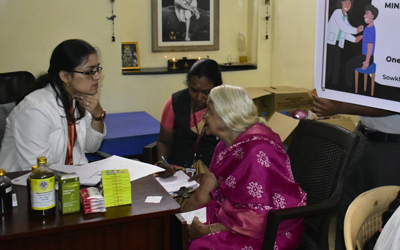
Capturing Every Detail for providing the best personalised care in Ayurveda
RUDRA stands for the third eye of Lord Shiva. The third eye of Lord Shiva represents the trained eye that is devoid of bias, passion and vested interest. In the context of the RUDRA Program, it denotes the involvement and participation of a team of well trained researchers to report clinical outcomes of Ayurvedic practice. The logistics of the RUDRA Program works around utilization of the waiting time that patients have to spend in the hospitals between registration and consultation. This waiting period is used creatively by subjecting the patient to a thorough clinical documentation by a team of researchers. The researchers prepare a comprehensive work up of the case or a summary depending on the available time. Registration staff and Epidemiologist collect the registration data and epidemiology questionnaire responses.
RAPID ASSESSMENT METHOD (RAM)
In the Out Patient Department, RUDRA documentation is done through a RAPID ASSESSMENT METHOD (RAM). There are three levels of RAM
- 1. Recording of only the complaints reported by patient
- 2. Recording of complaints reported by patient and general observations of researcher
- 3. Recording of complaints, observations and diagnosis.
The RAM approach will generate preliminary data on Health Seeking Behavior of patients seeking Ayurvedic and other traditional forms of health care.
COMPLETE ASSESSMENT METHOD (CAM)
In select cases, the COMPLETE ASSESSMENT METHOD (CAM) is adopted. The COMPLETE ASSESSMENT METHOD (CAM) is predominantly used in the In Patient Department but can also be adopted in important cases or in clinics with less inflow of patients. The CAM consists of the following steps – Recording of Complaints, Vitals, Clinical Observations, Examination of Systems, Lab Investigations and Imaging, Preliminary, Tentative, Provisional, Differential and Final Diagnosis. It also consists of recording of Ayurvedic Clinical Parameters and the Treatment Strategy being adopted. On the other hand, CAM approach generates in addition, preliminary safety and effectiveness data.
Why Rudra?
- Evidance based documentation
- Improves quality of patient care
- Supports research
- Promotes Ayurveda globally